


The M.A. Olympic Studies is a fully accredited, 120-credit master’s program designed for professionals who wish to continue working while pursuing their studies. This part-time program includes one intensive study week per semester, covering six modules that explore both theoretical and practical aspects of the Olympic Movement. Topics include Media and Commercialization, Sports Policies, and International Relations.
For more information and to apply, please visit the following application website: https://myspoho.dshs-koeln.de/qisserver/pages/cs/sys/portal/hisinoneStartPage.faces and a tutorial video to help applicants throughout the process. For further questions please reach out to Diese E-Mail-Adresse ist vor Spambots geschützt! Zur Anzeige muss JavaScript eingeschaltet sein!
General Overview
The programme implements a high-level, interdisciplinary curriculum in Olympic Studies to foster the links between the academic and the Olympic world. There are in total 6 Modules, which cover both the theoretical and practical framework of the Olympic Movement:
1. Ethics, Values and Olympic Education
2. Olympic Athletes and Elite Sport in Transition
3. Research Methodologies in Olympic Studies
4. Governance, Policy and Olympic Organizations
5. Olympic Games – Media and Commercialization
6. International Relations and the Olympic Movement
Funding opportunities for our program are provided through the Olympic Solidarity Scholarship Programme, in collaboration with the respective National Olympic Committees (NOCs), not directly by us.
The application period remains open until February 28 2025.
Sara Piffer, young promise of cycling has left us at the age of 19
Published in Neues von Panathlon International
She is the 425th victim in the last two years: a massacre for cyclists.
by Matteo Contessa
She was born in a land of cyclists, Sara Piffer, the young Trentine two-wheeler promise who was run over and killed by a car on Friday on the Rotaliana internal road connecting Mezzocorona and Mezzolombardo. She was born in Palù di Giovo, the village of Francesco Moser, to name but one. And in that land of cyclists she left forever. Soon. Too soon. Because at 19, whatever the cause, it is still too early to die. She was a competitor, Sara, and was training with her brother. She had started her career with Velo Sport Mezzocorona and had distinguished herself with a second place in the Madison in 2021. With the Mendelspeck Ge-Man, she had won last year in Corridonia, Marche, and had finished second in the Trentino time trial in Verla/Maso Roncador.
The motorist who hit her, a 70-year-old gentleman, explained that he was overtaking, but was dazzled by the sun and did not see the two boys coming in the opposite direction. He thought he was giving himself an extenuating circumstance with this explanation. Instead, he threw an aggravating circumstance at himself: on that stretch of road the carriageway is not wide and overtaking another car was already a borderline manoeuvre. If there was also the sun glaring down, making it impossible to see whether someone was coming in the opposite direction, then one had to wait until one had a full and clear view before initiating the manoeuvre.
Sara Piffer is not the number 9 cyclist in 2025 to lose her life. No, Sara is number 425 in the last 24 months. A carnage. Which didn't actually start at the beginning of 2023, it has been going on for a long time before that if we think that Michele Scarponi, along with Davide Rebellin undoubtedly the most illustrious victim on this list, was mowed down while training near his home in the Marche region in April 2017. Many cyclists are run over just like Sara Piffer, because they are unobtrusive figures in the roadway and ride at the edge of it. Those behind the wheel always think they have enough space to pass anyway. Instead, the space is often not there and those who are less stable always pay the consequences. And these are almost always competitive cyclists, because they are the ones who need long, evenly surfaced roads to train. They therefore ride on arterial roads frequented by mixed traffic. Cycle tourists, on the other hand, use the increasingly extensive and widespread network of cycle paths closed to motor vehicles for their outings
In both cases, those who ride on two wheels must observe very strict safety rules: helmet compulsory, front and rear lights always on, riding in single file and as close to the edge of the road as possible, fluorescent clothing and reflectors at various points on the bike to be visible from a distance even in poor visibility. But this is often not enough. The Italian Highway Code, already in its version prior to the current one, stipulated that there must be a distance of one and a half metres between the motor vehicle and the bicycle when overtaking. But almost never is this distance respected. Then there are accidents, injuries and deaths.
Something must be done to stop this carnage. But it is no longer just a question of written rules. It is a cultural issue, because the cyclist on the road cannot be considered the child of a lesser god by motorists. Everyone must do their part. And Panathlon International, which has numerous cyclist groups in different parts of the world, is certainly not backing down. Memoranda of understanding, even at national level, are important to make cycling safer. But they alone are not enough if a different culture is not promoted among those who use the roads by different means.
More is also needed. A very good idea has been making the rounds for some time now, and it was while commenting on Sara Piffer's death that Gazzetta dello Sport journalist Luca Gialanella gave it a strong voice: we need to start with driving school courses, including the study of the rules of engagement between motor vehicles and bicycles in the textbooks preparing for the licence and above all in the compulsory practical driving training for those who want to take it. This would be the right start to educating new generations of drivers to think of the roads as a place where four and two wheels can coexist.
In the meantime, Panathlon International's thoughts go out to those left behind: to her family members and in particular to Sara's brother who used to ride with her and will no longer be able to ride a bicycle. The pain is heartbreaking. And all of us cannot just be spectators to this carnage. In Italy and outside Italy.
(Translated with DeepL.com)

The General Secretariat's offices will be closed on Monday afternoon 27 January due to hydrogeological alert (orange from 3pm to 6pm) and Tuesday 28 January due to red alert (until 2pm) and orange alert (until 4pm)
Panathlon Club Lambayeque - Gala Élite del deporte, arte y cultura
Published in Neues aus den Clubs und die Bereiche
El Panathlon Club Lambayeque Perú, realizamos la Gala Élite del deporte, arte y cultura evento planificado para este primer semestre del año.
Se premió a los deportistas que lograron medallas en el 2024 y a los profesionales dentro del ámbito cultural. También entregamos tres sillas de ruedas a personas de bajos recursos y 01 instrumento musical al colegio nacional de alto rendimiento.


Ausserordentliche Generalversammlung am Samstag, den 14. Dezember um 15:00 Uhr (CET)
Published in Neues von Panathlon International
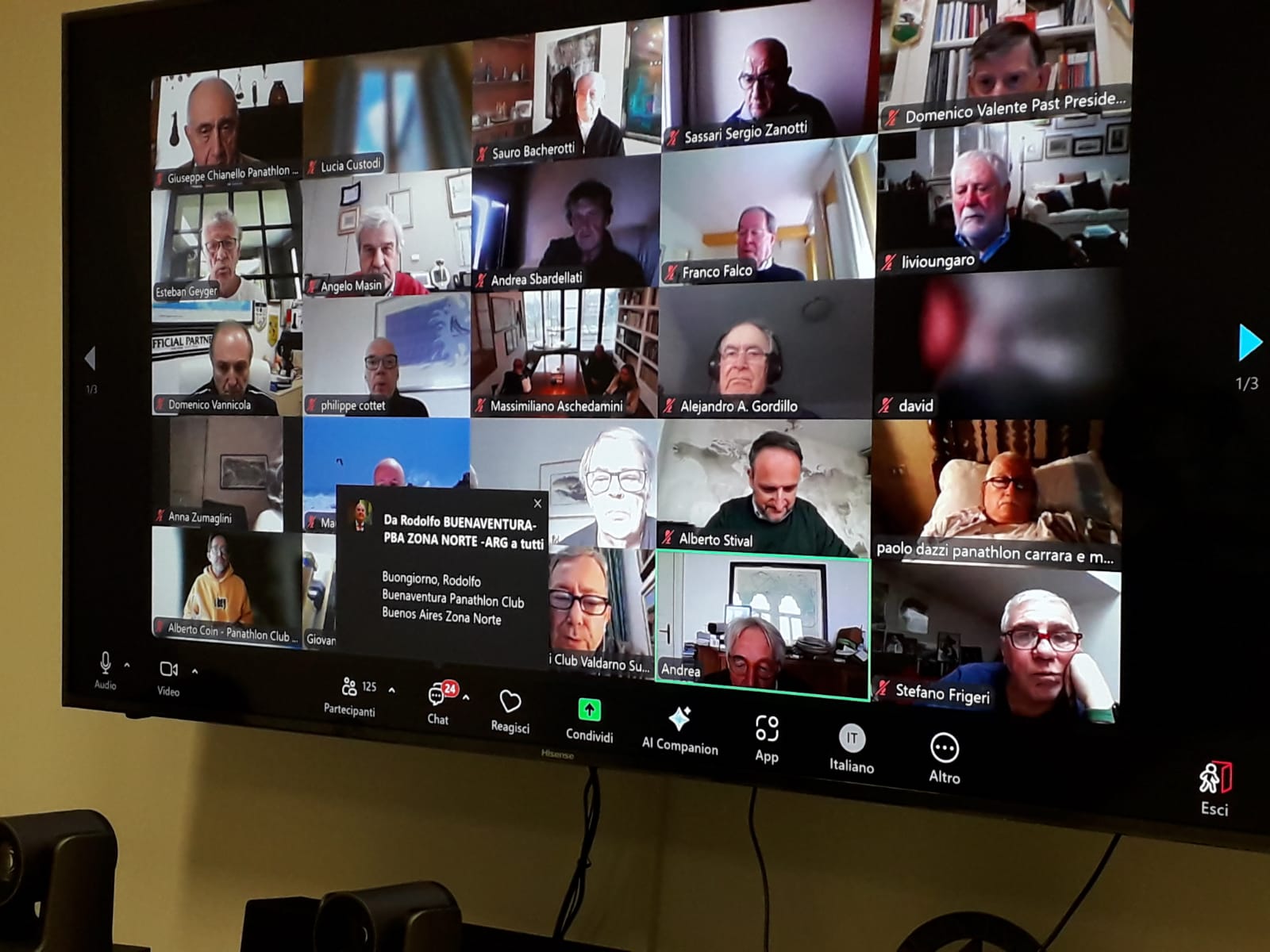
Zum ersten Mal in der Geschichte des Panathlon International wurde die ausserordentliche Generalversammlung im telematischen Modus gehalten. Das Event fand am Samstag, den 14. Dezember um 15:00 Uhr (CET) mit der Teilnahme von sogar 169 Panathleten statt, die über den Kernpunkt der Tagesordnung, die Erhöhung der Mitgliedsbeiträge an PI für die kommenden zwei Jahre, diskutierten. Präsident Giorgio Chinellato leitete die Arbeiten ein und ernannte den Vizepräsidenten, den Sekretär und die Stimmenzähler. Ebenfalls erklärte er die Gründe, weswegen der Internationale Rat die Erhöhung empfohlen hat.
Die Hauptgründe sind: die Notwendigkeit, die internationalen Aktivitäten der PI einschliesslich der Expansion und neuer Projekte zu unterstützen, die Tatsache, dass die Mitgliedsbeiträge seit über 20 Jahren nicht mehr erhöht wurden, die Gelegenheit, die Beiträge wieder an die Auswirkungen der Inflation anzupassen und den Einkommensverlust durch den Rückgang der Mitgliederzahl auszugleichen.
Viele italienische, amerikanische und europäische Clubs brachten ihre Unterstützung für den Vorschlag zum Ausdruck und erkannten die Komplexität des Zeitpunkts für die Clubs an, verstanden jedoch die Wichtigkeit, die Fortführung der internationalen Initiativen zu gewährleisten.
Diese Gründe wurden von einem Teil der Bewegung nicht geteilt. Einige technische Probleme beim Empfang der Abstimmungs-E-Mails, die manchmal falsch versendet wurden, führten zu einer leichten Verzögerung des Abstimmungsprozesses. Hier die Zusammenfassung: Von 161 registrierten und 156 zur Abstimmung zugelassenen Clubs drückten nur 136 ihre Präferenz aus - 75 dagegen, 56 dafür, 5 Enthaltungen, darunter 2 leere Stimmzettel.
Der Präsident nahm die Entscheidung der Versammlung zur Kenntnis und wies darauf hin, dass die Arbeit des IP entsprechend dieser Wahl neu organisiert werde. Anschliessend richtete er einen besonderen Dank an alle, die eine hervorragende Arbeit geleistet hatten. Er dankte auch den Teilnehmern für ihre Anwesenheit.
Abschliessend wünschte der Präsident ein frohes Weihnachtsfest und ein gutes neues Jahr und erklärte die Versammlung um 17.15 Uhr für beendet.


Governance’ - “Development & Solidarity”- IV Webinar organised by the IOC for 2024
Published in Neues von Panathlon International
Last 11th December Panathlon International, the Secretary General Callo Simona together with Rossi Monica Administrative Secretary, participated in the fourth and last webinar organised by the IOC for 2024 dedicated to ‘Good Governance’. On this occasion the focus was ‘Development & Solidarity’.
In addition to the PI there were 40 other participants representing Sports Federations and Associations. The suggestion that arose after the meeting is to create a Good Governance programme for the coming four-year period 2025/2028.
Here are the main points discussed, which are also well specified in the IOC Code of Ethics:
Distribution of resources
Financial resources generated by sport must be reinvested in sport, with a focus on the development of sport and the direct or indirect support of athletes. Financial revenues must be allocated fairly and efficiently to ensure balanced and attractive competitions, must be dedicated to promoting fair, inclusive and diverse sport, with a focus on gender equality. Financial resources must be used through clear and transparent processes aligned with the development objectives of sport and the principle of solidarity must be a key element in their allocation.
To ensure responsible management of funds, specific mechanisms must be put in place to monitor and evaluate the use of resources by beneficiaries.
For all these reasons, the IOC will monitor the use of donated funds at 3 well-defined levels.
Environmental and Social Responsibility
All sports organisations will have to commit to minimising negative impacts and maximising positive ones by taking responsibility through the organisation of events, promoting gender equality, inclusion and diversity; respecting and promoting human rights; and pursuing environmental excellence.
Collaboration between Sports Organisations and Government Authorities
Sports organisations and government authorities must collaborate and coordinate their actions, respecting each other's jurisdictions and responsibilities, and avoiding undue interference. This collaboration must foster the development of sport at all levels; support and protect athletes, counteracting doping, all forms of manipulation, corruption in sport, as well as harassment, abuse and violence; use sport as a tool to protect young people from crime.
Sports development programmes must be designed to contribute to the Sustainable Development Goals (SDGs) and in particular promote the creation of partnerships between sports organisations, and work towards the expansion and maintenance of sports facilities in countries in need.
Autonomy of the Olympic Movement
During the meeting it was reiterated that all sports organisations must maintain their autonomy and political neutrality in operations and governance. It is essential to reject any form of political, religious or economic pressure that could hinder compliance with the Olympic Charter.
Finally, sports organisations should seek sources of funding that are compatible with the Fundamental Principles of Olympism, promoting diversification of revenues to ensure the sustainability and independence of their activities.
In short, ‘good governance’ is an opportunity to consolidate credibility. We all have a role to play towards our organisation and our members.
During the webinar, William Glenwright, Head of Global Development for the International Cricket Council, Julie Marks (Sustainability Working Group) and Saurav Ghosal (Co-Chair, Athletes' Commission) for the World Squash Federation spoke, bringing their experience in implementing Good Governance milestones.
The meeting ended with the promise of new webinars during 2025.
For more information, this is the link https://www.ipacs.sport/news/good-governance-webinars-conclude-successfully
(translated by Deepl)
CIFP - Bewerbungen um die Weltpreise 2024
Published in Neueste
Das Internationale Fair-play-Komitee hat den 15. Februar 2025 dieses Jahres als Einsendeschluss für Bewerbungen um die Weltpreise 2023 festgelegt.
Wir sollten diese Angaben bis spätestens 31. Januar 2025 erhalten.
- Nomination Guide 2024
- Nomination - Act of Fair Play
- Nomination - Career in the spirit of Fair Play
- Nomination - Fair Play Trophy for the Youth
- Nomination - Promotion of Fair Play
Euro News 26 & 27 November 2024 - Brussels -“Beactive Awards”
Published in Neues von Panathlon International
On Tuesday 26 November, the gala evening of the ‘beactive awards’ took place in
the presence of Mrs Ahrenkilde Hansen,director General for Education, Youth, Sport and Culture European Commission and Mrs Floor Van Houdt , Head of EAC Unit Sport.
Paul Standaert, was present at the gala evening and the debriefing as representative of the International Board and President Chinellato.
Four awards were presented during the gala evening.
Prof Em Thierry Zintz, past member of Panathlon’ s scientific commission was member of the jury that granted an award to:
- Sport Union Austria, Education award
- Metropole de Lyon France, Workplace award
- Fundacj Rozwoju Sportu Poland, Across Generation award
- Allessio Bernabò Italy, Local Hero award
The evening was followed by a interesting keynote address by former Olympic Gold Fencing, Dr Diana Bianchedi, Chief Strategy Planning &Legacy Milano Cortina 2026.
As always, this event was a fine opportunity to connect with sport enthusiasts from EU countries.
The following morning was the debriefing of the 2024 European Week of Sport. This year was the participation record was again broken.
In 24 countries, 15 million persons have participated at one of the 50.000 Events.
Panathlon International is partner of EWOS since 2015. Since 2020 the PI clubs have accelerated their participation, and the Italian Panathlon Clubs are in the lead. More than 20 Italian clubs organized an event in participation of EWOS.
Paul Standaert is grateful to all the clubs and their presidents in joining this European initiative.
The workplan for 2024-2027 was presented with a focus on three domains:
-integrity and values in sport
-social economic and sustainable dimension of sport
-participation in sport and healthy enhancing physical activity
In 2025 EU will celebrate the 10th anniversary of this great initiative.
As this will be a special year for EWOS, Panathlon could develop an one common initiative that unites clubs all over Europe in EWOS 2025.